The Real Problem With Package Trade Reporting
Ask anyone in derivatives operations what managing multi-leg trades looks like in practice, and the answer usually involves a lot of back-and-forth with engineering. The logic that determines how individual leg prices roll up into an overall package price has historically lived deep in back-end systems. Changing it means raising a ticket, waiting on a development cycle, and hoping the output matches what you actually needed.
That dependency is the problem KOR's Package Trade Hub is built to fix. KOR has brought the full configuration and management of package trades into the front end of the application, so the people accountable for regulatory reporting can own it directly, without writing a line of code or filing a single engineering request.
What Is a Package Trade?
A package trade is a group of individual derivatives executed together as a single transaction. A useful analogy: booking a holiday package versus buying each component separately. When you book a flight, a hotel, and a transfer as a bundle, you get a price that reflects the fact that you committed to all three at once. Each component may carry a lower individual price than it would at standalone market rate.
Multi-leg derivatives work the same way. A client entering into an FX swap consisting of an FX Spot and FX Forward gets a package spread that reflects the combined execution, with individual components priced as part of the whole deal.
This creates a specific regulatory reporting challenge. If only the individual leg prices are published, they can look anomalous. A price below market rate appears to be an error unless the context is clear: it was part of a package. Reporting both the overall package price and the individual component prices gives regulators the full picture and removes any ambiguity about why a leg was priced the way it was.
Getting that right is one thing. Keeping it right when trades are amended is where most platforms fall short.
Why Engineering Has Always Been in the Loop
The logic required to calculate package prices is specific to the type of trades involved and varies by client and jurisdiction. For most firms, that configuration has lived in a back-end integration built and maintained by a software team. Operations and compliance professionals can see the outputs but have no visibility into how the logic works or the ability to adjust it when they need to.
When something looks wrong, the answer has been to escalate. When rules change, the answer has been to wait. That is a structural problem that affects firms of every size. Most regional and tier-one banks trading FX or commodities are dealing with package reporting in some form, and the common thread is that the people responsible for the reporting have rarely been the ones in control of how it works.
KOR fixes that by putting the configuration where it belongs: in the hands of the operations team.
What KOR's Package Trade Hub Gives You
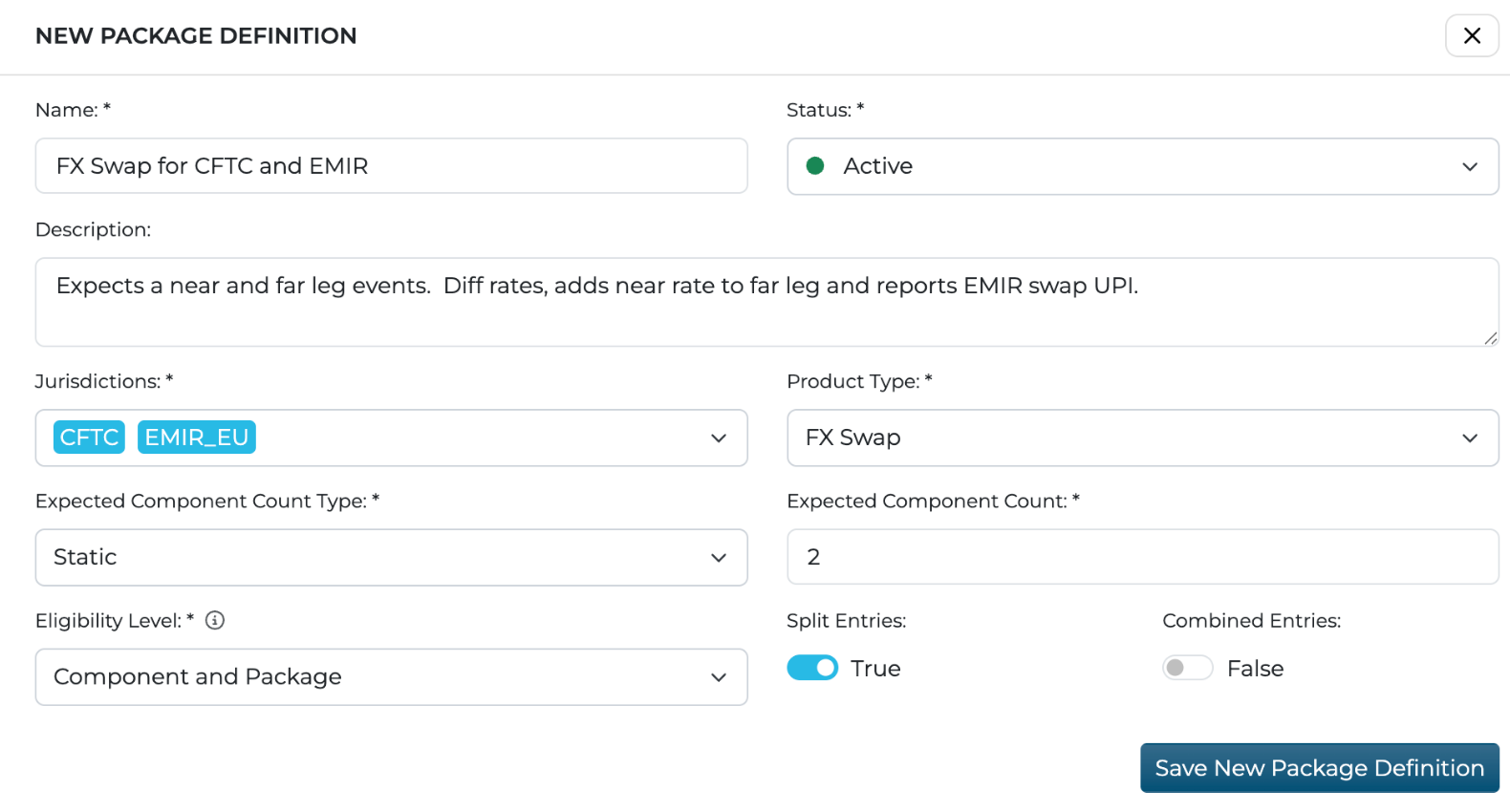
Package Definitions You Can Configure and Own
You can define package price calculation logic directly in the KOR interface. The formula, the inputs, and the output are all set and managed in the application. If the overall package price is the sum of three leg notional values, that is configured in the UI, visible to your team, and editable without any back-end work.
When a package price looks unexpected, there is no need to escalate or investigate a black box. The configuration is right there. You can show exactly what logic is being applied, which trades feed into it, and what the calculation produces. Fully transparent, fully auditable, fully yours.
Sync Management That Fits How Your Team Works
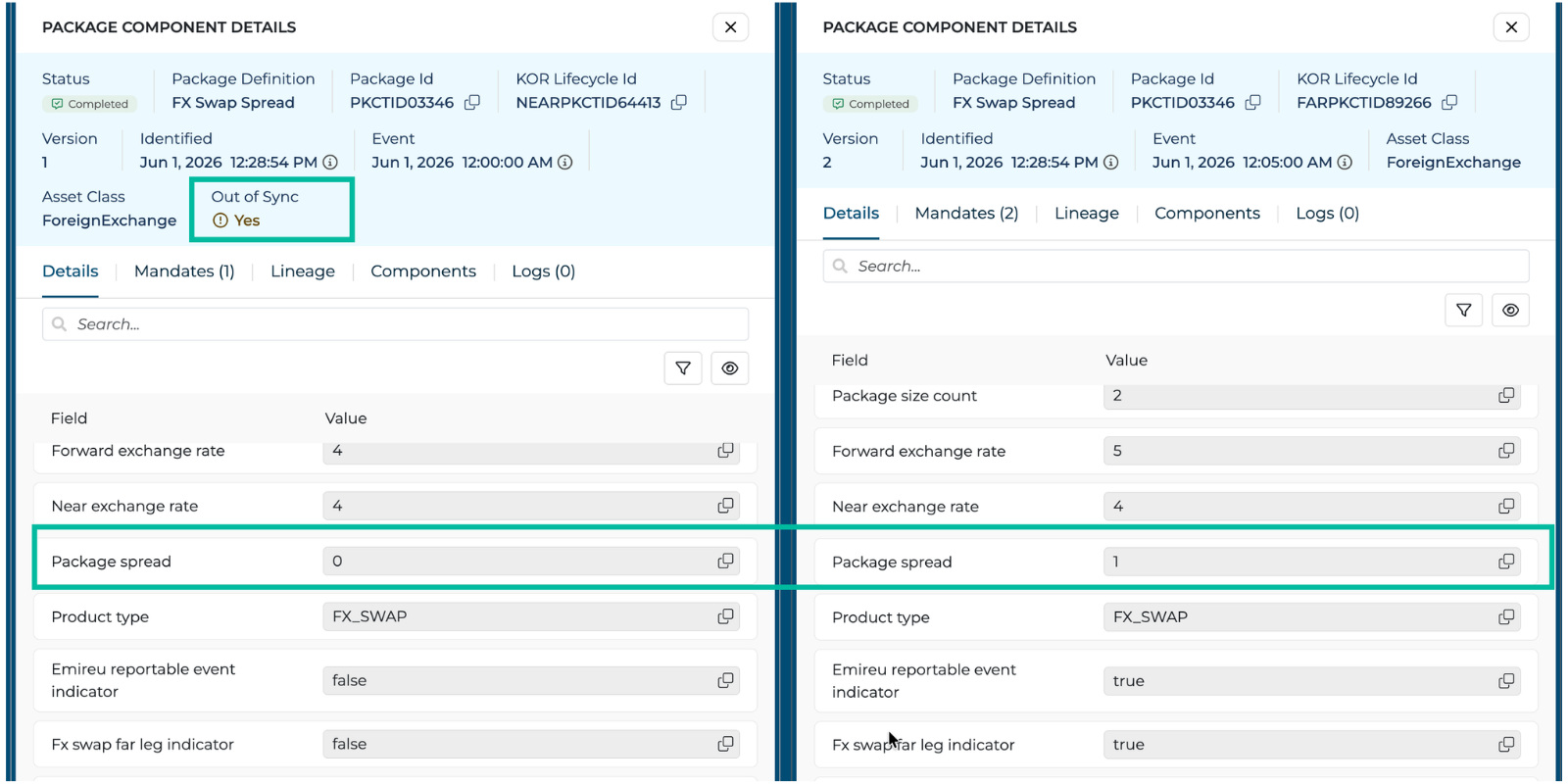
Amending one leg of a package trade creates a downstream problem: the overall package price, which depends on all its legs, can become stale. Most platforms respond by either re-reporting every leg automatically, flooding downstream systems with noise, or doing nothing and leaving you with regulatory risk you may not catch until it is too late.
KOR gives you the choice. The ‘Update All Components’ indicator lets you decide how corrections flow. Submitting a one-off correction? Turn it on and every leg in the package syncs in a single pass, no follow-up required. Receiving corrections incrementally across the day? Let each one land as it arrives and trigger a single API call at the end to bring every out-of-sync component into line.
Monitor for Sync
Not every field change is worth a sync. The ‘Monitor for Sync’ toggle lets you define which trade fields carry regulatory weight and should count toward sync status. Fields that matter stay in scope. Fields that do not stop generating false alarms. Less noise, more accurate package health, and fewer distractions for your team.
Package Health Visibility at a Glance
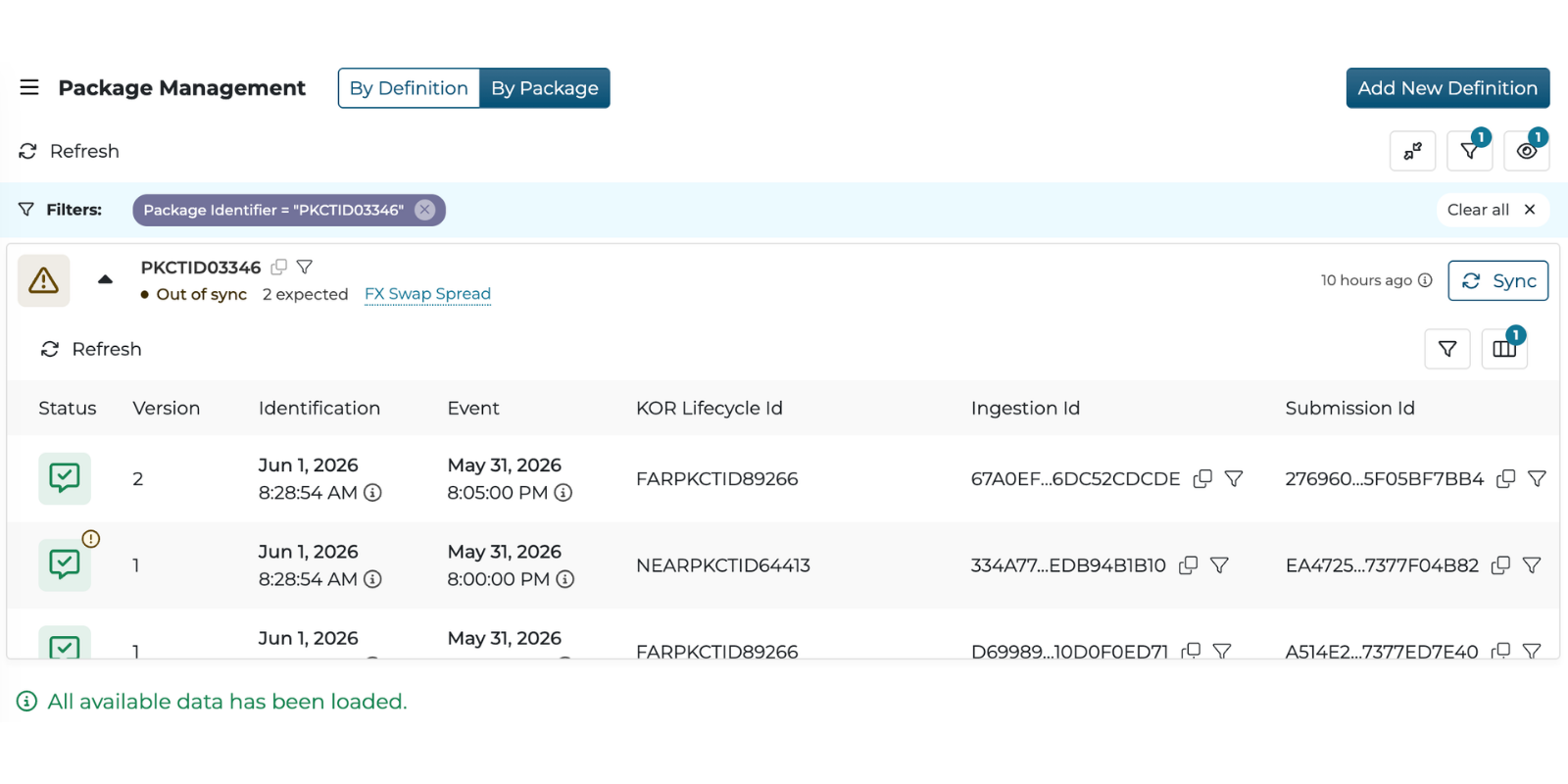
Every package row in KOR displays a status icon showing whether its components are in sync. You can drill into any component and trace its full lineage end to end without leaving the screen. No switching between systems, no escalating to engineering to investigate a discrepancy.
A Complete Audit Trail, Built In
Every change to a Package Definition is logged with the old value, the new value, the user, and a timestamp. When a question comes up in a regulatory review or an internal audit, the answer is already in the platform. Audit-ready by default, not as an afterthought.
Who Is Package Trade Hub For?
If you are in operations or compliance and you are responsible for multi-leg derivatives reporting, this is built for you. Specifically for the situation where the reporting logic has existed in some form, but the people accountable for it have had to go through engineering to change anything about how it works.
Package trades are common across FX, commodities, and structured derivatives, and the requirement applies broadly, from mid-sized regional banks to tier-one institutions. This includes firms reporting under EMIR and MiFIR in Europe, CFTC in the US, ASIC in Australia, MAS in Singapore, and OSC in Canada. If your firm already runs package calculations externally and feeds results into KOR, this brings that logic inside the platform where you can manage and audit it directly. If you are building this capability for the first time, it removes the engineering overhead entirely.
Either way, you get a configurable, transparent, auditable solution that your team can own.
The Bottom Line
Package trade reporting has always been complex. What has made it harder than it needed to be is that the configuration and management of that complexity has been locked away from the people responsible for it, sitting in back-end systems that only engineers could touch.
KOR's Package Trade Hub puts the logic in the open, the controls in the hands of your operations team, and the audit trail in the platform by default. When something needs to change, it no longer requires a development cycle to fix it.
That is package trade reporting the way it should have worked from day one.
Contact KOR
Ready to take back control of your multi-leg derivatives reporting and eliminate unnecessary engineering bottlenecks? The KOR team is here to show you how the Package Trade Hub can integrate seamlessly into your current workflow.
Schedule a Demo: See the KOR Package Trade Hub interface in action. Contact our solutions team at sales@korfinancial.com.
Speak with an Expert: Have questions about specific asset classes or local jurisdictional requirements? Reach out directly via our contact page at korfinancial.com.
General Inquiries: For all other questions about the KOR reporting platform, get in touch at info@korfinancial.com.